Foreign Policy

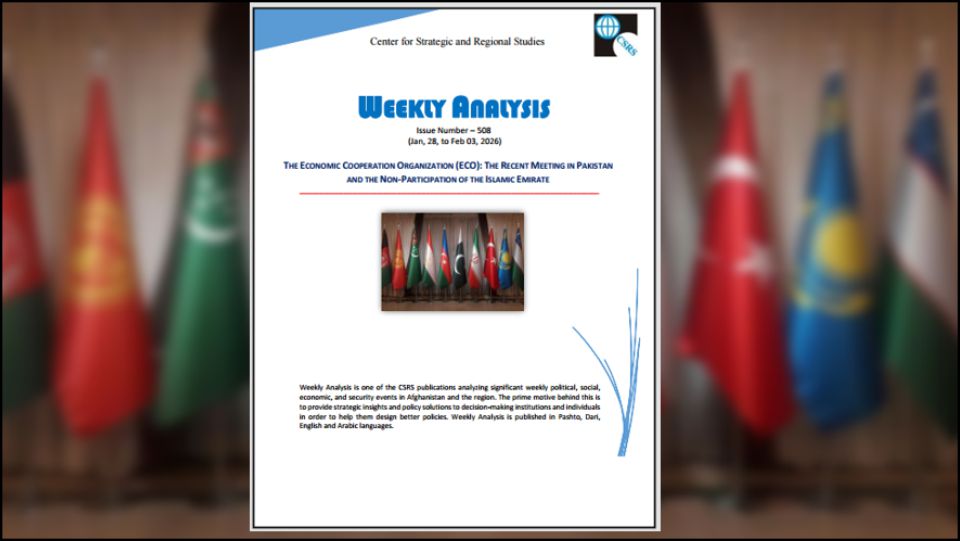
The Economic Cooperation Organization (ECO): The Recent Meeting in Pakistan and the Non-Participation of the Islamic Emirate

The Economic Cooperation Organization (ECO) was established to strengthen regional coordination, promote free trade, support regional economic development, and enhance scientific and cultural exchanges. Holding the recent ECO meeting in Pakistan, with the participation of all member states except Afghanistan, indicates that Pakistan is viewed as an important economic partner by other member countries and enjoys a significant level of regional trust. Hosting such meetings also increases Pakistan’s visibility and influence in the region.

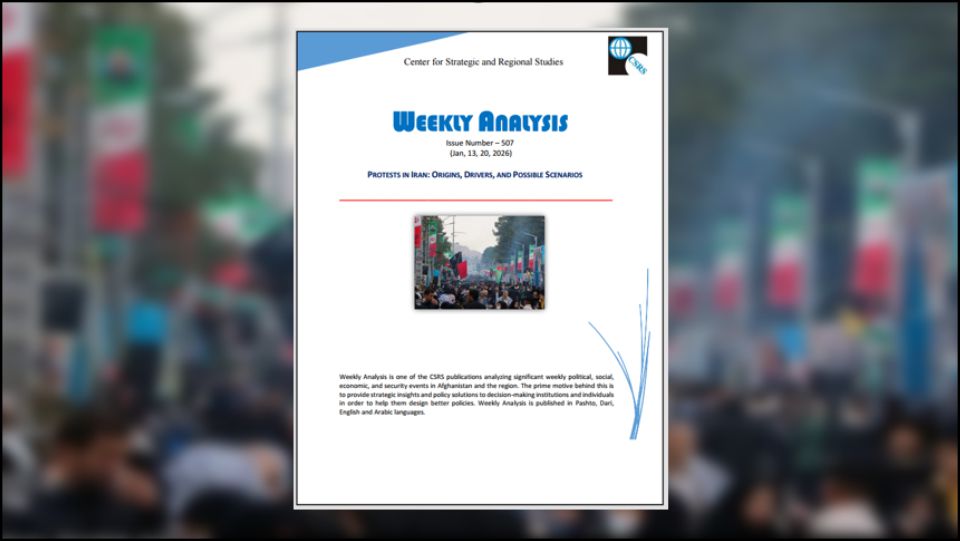
Protests in Iran: Origins, Drivers, and Possible Scenarios

The recent protests in Iran, which initially emerged from economic grievances among market traders in response to currency volatility and deteriorating living conditions, rapidly evolved into a broad-based movement with a distinctly political character. This transformation reflects the depth of Iran’s structural discontent…

An Analysis of the United States’ Military Attack on Venezuela

The United States’ military action against Venezuela and the unlawful detention of the country’s president, Nicolás Maduro, and his spouse constitute, from the perspective of international law, a clear violation of the fundamental provisions of the Charter of the United Nations.

The Tehran Meeting and the Absence of the Islamic Emirate: An Analytical Overview

The Tehran meeting can be assessed as Iran’s attempt to position itself as one of the key diplomatic reference points for addressing Afghanistan-related issues. A country that has long faced severe Western pressure and relative isolation, Iran appears to have used this initiative to demonstrate its continued capacity to break out of diplomatic isolation and exert influence over regional affairs.

The Significance of Russian President Vladimir Putin’s Visit to India

President Putin’s visit to India took place at a highly sensitive moment in global strategic transformation—one shaped by the Ukraine war, Western sanctions, shifts in global energy markets, NATO’s expansion, and the emergence of a new Eurasian political landscape.

Alternative Trade Routes for Afghanistan Beyond Pakistan: Challenges and Solutions

Although Afghanistan’s trade has long been dependent on Pakistan’s transit routes, the country is not without alternatives. With support from neighboring and regional states that maintain close relations with the Islamic Emirate,

Sudan Through History: Political Transitions, Civil War, and Humanitarian Crisis

A comprehensive review of Sudan’s political and military trajectory—from independence to the 2019 revolution—demonstrates that the country’s power structure has consistently oscillated among military regimes, partisan elites, and social forces.

The Shift in Tajikistan’s Foreign Policy Toward the Islamic Emirate of Afghanistan

An examination of Tajikistan’s behavioral and rhetorical patterns indicates that the country’s foreign policy toward the Islamic Emirate of Afghanistan has undergone a fundamental transformation

The Defense Pact between India and the United States and Its Implications for the Region and Afghanistan

On October 31, 2025, India and the United States signed a ten-year defense cooperation agreement (2025–2035) aimed at strengthening military ties, enhancing logistical and technical collaboration in the defense sector, and facilitating trade in arms and defense technologies.

Mullah Amir Khan Muttaqi’s Visit to India and the Shift in Policies

India has historically viewed Afghanistan through the prism of its rivalry with Pakistan. Whenever Pakistan’s influence in Afghanistan increased or its relations with the Afghan government improved, India’s presence and engagement tended to decline. For instance, during the Soviet invasion of Afghanistan, when Pakistan supported the Mujahideen, India sided with the Soviet Union.

Scroll to top