Security

United States–Iran Negotiations: Outcomes and Future Scenarios

Iran’s return to negotiations with the United States does not merely reflect a tactical adjustment; rather, it appears to be the result of a broader erosion in Tehran’s deterrence-based strategic calculations. The weakening of proxy networks, the attrition of military capacity, increasing international isolation, and the widening state–society divide have collectively raised the costs of sustained confrontation beyond what the Iranian system can comfortably absorb. In this context, renewed diplomacy represents a recalibration driven by structural pressures rather than voluntary strategic transformation.
Afghanistan’s Participation in the China–Pakistan Economic Corridor (CPEC) and India’s Reaction

China aims to expand its Belt and Road Initiative (BRI) by incorporating Afghanistan into the China–Pakistan Economic Corridor (CPEC). However, the tense relationship between the Islamic Emirate of Afghanistan and Pakistan remains a major obstacle.

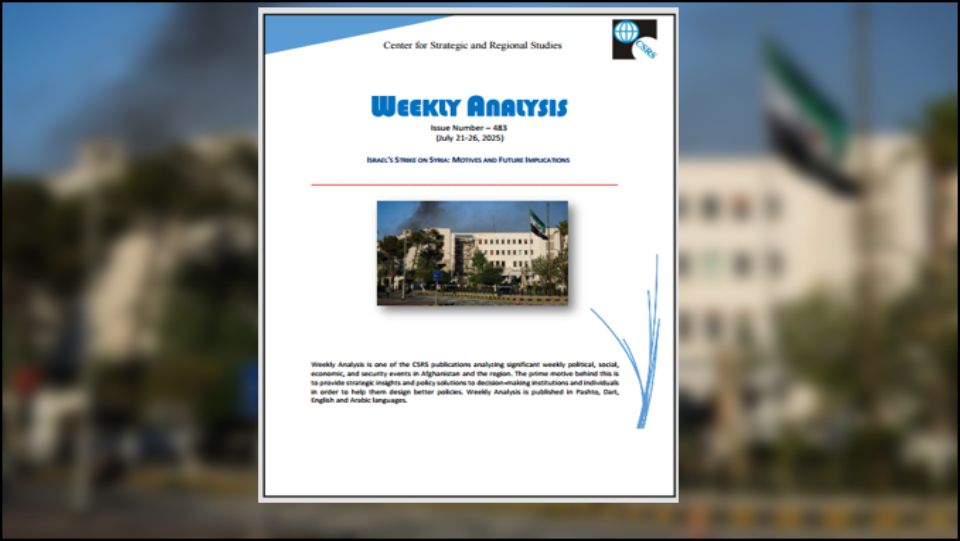
Israel’s Strike on Syria: Motives and Future Implications

Israel’s recent attack on Syria, officially justified as a move to protect the Druze minority, targeted the Ministry of Defense in Damascus. However, beyond this stated goal, Prime Minister Benjamin Netanyahu appears to have broader motives. One of them is to keep Israel engaged in conflict as a way to delay his ongoing corruption trials, portraying himself as a wartime leader facing national security threats.

Foreign Policy of Syria’s Interim Government: Principles, Actions, and Challenges

Although the interim government in Syria has only been in place for three months, it has made notable progress in both domestic and foreign affairs. Under the leadership of Ahmad Al-Shara, the government has taken significant steps to reduce Syria’s international isolation.

Scroll to top