
By: Center for Strategic & Regional Studies
Note: Click here for the PDF file of this analysis.
___________________________________________________________________
In this issue:
-
- A Look at the Security Agreement between Russia and the Islamic Emirate of Afghanistan
- Elevating Russia’s Relations with the Islamic Emirate to the Level of Strategic Engagement
- The Approach of the Islamic Emirate in Reshaping Moscow’s Perception of Afghanistan
- Benefits of Signing a Military-Technical Agreement with Russia for the Islamic Emirate
- Benefits of the Agreement for Russia
- Impact of the Agreement on Central Asian States
- Likely Western and U.S. Responses to the Agreement
- Conclusion
- Recommendations
- References
______________________________________________
Introduction
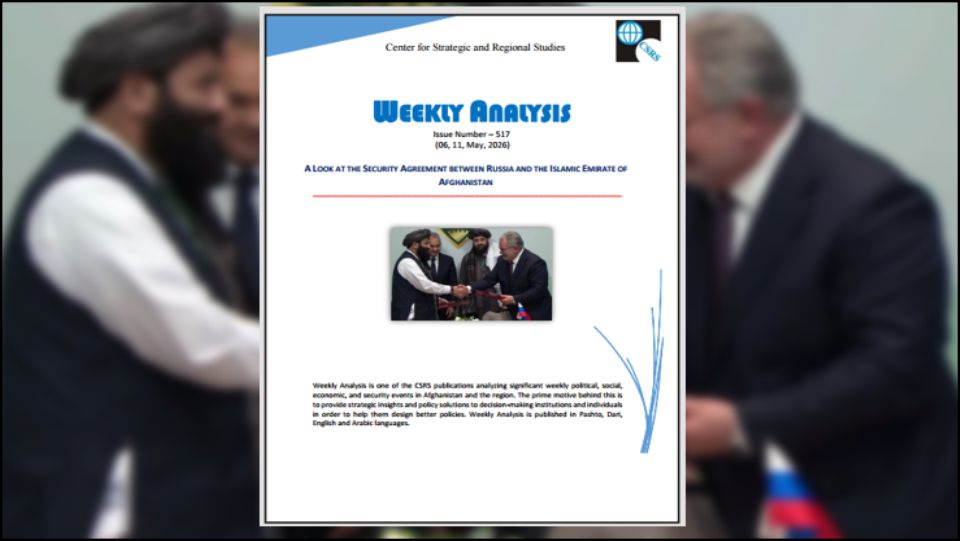
Russia and the Islamic Emirate of Afghanistan have recently signed an agreement on military-technical cooperation. Although the full text and operational details of the agreement have not yet been made public, official statements from both sides suggest that it primarily covers the repair and rehabilitation of Russian-made military equipment in Afghanistan, the strengthening of military infrastructure, and broader technical cooperation in the defense sector.[1] While the agreement may initially appear to be a limited technical arrangement, its implications are considerably broader. It should not be viewed merely through the lens of arms maintenance or military equipment. Rather, the agreement reflects a significant development in the evolving relationship between Moscow and Kabul, with potential consequences for Afghanistan’s defense capacity, its regional position, the security calculations of Central Asian states, and the wider geopolitical rivalry between Russia and the West. This development also raises a central analytical question: what factors have contributed to Russia’s changing approach toward the Islamic Emirate, and why is Moscow now willing to engage with the Kabul authorities in a sensitive field such as security and defense? Against this backdrop, the present article examines the recent agreement through four interconnected dimensions: first, the factors behind Russia’s shift in perception toward the Islamic Emirate; second, the implications of the agreement for the authorities in Kabul; third, Russia’s interests and strategic objectives in expanding cooperation with the Islamic Emirate; and fourth, the regional and international consequences of this emerging security engagement. The main argument of this article is that the recent military-technical agreement should not be understood as a purely technical arrangement. Instead, it signals the gradual elevation of Russia–Islamic Emirate relations toward a more strategic level and reflects the broader geopolitical realignments that have taken shape in the region following the withdrawal of the United States from Afghanistan.
Elevating Russia’s Relations with the Islamic Emirate to the Level of Strategic Engagement
In international relations theory, cooperation among states can be understood across different levels, ranging from economic and commercial relations to political, security, and defense cooperation. The key distinction between these levels lies in the degree of commitment involved, the sensitivity of information exchanged, and the level of mutual trust required. Economic cooperation, while important, does not usually require states to disclose critical information or compromise core security considerations. By contrast, military and security cooperation is directly linked to sovereignty, national security, and the political survival of states. For this reason, governments rarely enter into such forms of cooperation with actors whose stability, durability, and reliability remain uncertain. From this perspective, Russia’s entry into military cooperation with the Islamic Emirate goes beyond a purely technical, pragmatic, or short-term arrangement. It suggests that Moscow increasingly views the Islamic Emirate as an influential and reliable actor in the region’s security equations. More importantly, Russia no longer appears to perceive the Islamic Emirate as a direct threat to itself or to its surrounding security environment; rather, it has begun to regard Kabul as a partner with whom certain strategic interests can be pursued. In international politics, the deeper and more sensitive the level of cooperation between two actors, the greater the degree of trust and the stronger the indication of shared long-term interests. This logic is increasingly visible in Russia’s evolving engagement with the Islamic Emirate. Nevertheless, an important question arises: why has Russia undertaken such a significant shift in its foreign policy toward the Islamic Emirate within a relatively short period of time—particularly over the past two or three years? More specifically, what factors have contributed to the transformation of the Islamic Emirate from a perceived threat into a reliable partner for Moscow? This shift in perception can be attributed to several factors, the most important of which is the conduct and approach of the Islamic Emirate toward Russia and its surrounding security environment.
The Approach of the Islamic Emirate in Reshaping Moscow’s Perception of Afghanistan
More than any other factor, Russia’s increasingly positive perception of the Islamic Emirate should be understood as the result of the Emirate’s own calculated, cautious, and de-escalatory conduct toward Russia and its surrounding security environment after its return to power. Following 2021, Moscow faced a fundamental question: would the Islamic Emirate turn Afghanistan into a source of instability and extremism spilling over into Central Asia, or could it function as a force for stability? The Emirate’s practical behavior over the past several years has, to a considerable extent, shaped Moscow’s answer to this question. First, contrary to many initial concerns, the Islamic Emirate has refrained from pursuing a policy of exporting revolution or mobilizing Islamist movements in neighboring countries such as Uzbekistan, Tajikistan, and Turkmenistan. Nor has it attempted to present itself as the leader of Islamic movements across the region. For Russia, which views the security of Central Asia as directly linked to its own national security, this avoidance of cross-border intervention has carried strategic significance. Second, after assuming power, the Islamic Emirate adopted a state-centered approach and sought to engage formally with regional governments. For the Kremlin, this approach was interpreted as a sign of the Islamic Emirate’s gradual transition from an “insurgent movement” into a governing actor. Third, in the security sphere, the Islamic Emirate demonstrated that it considers Islamic State–Khorasan Province (ISKP) a serious threat to its own authority and has actively confronted the group. From Moscow’s perspective, ISKP represents the most significant threat emanating from Afghanistan. Therefore, the more the Islamic Emirate confronts ISKP, the more it becomes part of Moscow’s solution to dealing with a dangerous common adversary. Fourth, the Islamic Emirate could have invoked the historical memory of the Soviet occupation of Afghanistan to generate political tension with Russia. In practice, however, it has avoided this path by distinguishing between contemporary Russia and the former Soviet Union. In doing so, it has prioritized pragmatic cooperation over ideological confrontation. Fifth, the Islamic Emirate’s serious and effective campaign against narcotics cultivation and trafficking has also contributed to the formation of a more favorable perception in Moscow. Sixth, and more importantly, the Islamic Emirate has demonstrated a relatively stable and predictable pattern of behavior toward Russia and the Central Asian states. In international relations, great powers often value predictability even more than ideological alignment, because it enables long-term planning and strategic calculation. For decades, Russia’s engagement with the Islamic Emirate was shaped by uncertainty and strategic ambiguity, largely because of concerns over the movement’s unpredictability. However, the Emirate’s comparatively stable conduct after 2021 has helped reduce these concerns. Therefore, it can be argued that Russia’s rapprochement with the Islamic Emirate is not merely the product of Moscow’s geopolitical necessities. A significant part of this shift is also the result of the Islamic Emirate’s own calculated approach, through which it has sought to reassure Moscow that Afghanistan under its rule will not become a source of exported instability, extremism, or interference in the affairs of neighboring states. If Russia today views the Islamic Emirate as a potential partner in the military and security spheres, this is not only due to changing calculations within the Kremlin, but also the outcome of several years of cautious, pragmatic, and de-escalatory conduct by the Islamic Emirate toward Russia and Central Asia.
Benefits of Signing a Military-Technical Agreement with Russia for the Islamic Emirate
The benefits and strategic utility of the security agreement with Russia for the Islamic Emirate can be assessed across several militaries, security, political, and geopolitical dimensions. At the military level, the agreement creates an opportunity to restore a significant portion of the Russian and former Soviet military equipment and weaponry currently available in Afghanistan, much of which has become non-operational over the years due to aging, a shortage of spare parts, and the absence of technical support. Cooperation with Russia could help revive these capacities, while also facilitating access to spare parts and new equipment at lower cost and with greater ease. In addition, the Islamic Emirate would have the opportunity to benefit from Russian technical and training expertise, including by sending its officers and personnel to Russian training centers in order to enhance their military, intelligence, and technical capabilities. In the military-security sphere, closer cooperation with Moscow could strengthen the Islamic Emirate’s capacity to respond to certain hostile states, as well as threats posed by Islamic State–Khorasan Province (ISKP) and other transnational armed groups. Access to advanced Russian equipment, intelligence resources, and security experience could further enhance the Emirate’s surveillance and counterterrorism capabilities. In this regard, Mullah Mohammad Yaqoob Mujahid, the Minister of Defense of the Islamic Emirate, stated after returning from Moscow that “we are working to ensure that, from now on, Pakistan will not dare to attack Afghanistan.” Similarly, according to the BBC, a source has stated that Russia has agreed to provide the Islamic Emirate with air-defense equipment. Beyond the military-security dimension, the agreement also carries political significance. For the Islamic Emirate, it represents an important step toward reducing international isolation, as security cooperation with a major power suggests that the Emirate is gradually being accepted as an influential actor and a party with which regional powers are willing to engage. At the geopolitical level, this cooperation could increase the Islamic Emirate’s room for maneuver and reduce its dependence on certain other actors.[2] Moreover, closer ties with Russia may provide the Islamic Emirate with a degree of political deterrence, sending a message to regional states that Afghanistan is no longer an isolated country without external support. Ultimately, the agreement may help the Islamic Emirate reshape its image from that of a former “insurgent movement” into that of a responsible government and regional security partner. Such a transformation could, in turn, pave the way for broader economic, political, and security cooperation with Russia and other regional powers.
Benefits of the Agreement for Russia
For Russia, close and strategic engagement with the Islamic Emirate serves several key interests. First, it enables Moscow to contain security threats in Central Asia. Russia remains concerned about the possible spread of destabilizing armed groups from Afghanistan into Tajikistan, Uzbekistan, and Turkmenistan. From Moscow’s perspective, cooperation with the ruling authority in Kabul is less costly and more effective than confrontation with it. Second, the agreement helps Russia prevent the return of Western influence to Afghanistan. Moscow views Afghanistan as part of its broader surrounding security environment and has little interest in seeing the revival of a Western political, intelligence, or military presence in the country. Third, the agreement also fits within Russia’s broader geopolitical competition with the United States. By maintaining close relations with the Islamic Emirate, the Kremlin signals that it can still project influence in regions that were once heavily shaped by Washington’s presence and strategic priorities. Fourth, Afghanistan offers potential economic opportunities for Russia. With its rich mineral resources and its geographic position as a transit bridge between Central and South Asia, Afghanistan could, in the long term, become part of emerging regional trade and connectivity corridors. Fifth, Russia has been engaged in the war in Ukraine for several years. In this context, rebuilding political, economic, and military relations in strategically attractive regions such as Afghanistan may help Moscow reduce some of the diplomatic and geopolitical pressures generated by the war. Ultimately, beyond these tangible interests, the two sides also share a broader point of convergence: opposition to a Western-led international order. Russia seeks a multipolar world in which Western influence is more limited, while the Islamic Emirate remains dissatisfied with the current international structure, which has subjected it to sustained political and economic pressure. Therefore, Russia’s rapprochement with the Islamic Emirate may, at least in this part of the world, challenge a Western-centered order that both sides view as unfavorable and reduce its negative effects on their respective interests.
Impact of the Agreement on Central Asian States
The military cooperation agreement between Russia and the Taliban can be understood as more than a bilateral arrangement; it may also be seen as an attempt to link Afghanistan more closely with Moscow-backed security arrangements in Central Asia. Over the past three decades, Russia has remained one of the most important security actors in the region. Through its military presence, intelligence cooperation, and close relations with Central Asian governments, Moscow has played a significant role in managing cross-border threats. Afghanistan, however, has largely remained outside this regional security framework. This has long generated concerns among Central Asian states, particularly Tajikistan, Uzbekistan, and Turkmenistan. The recent agreement sends a message that Moscow is no longer content with merely protecting the southern borders of Central Asia. Rather, it is seeking to manage threats at their source through direct cooperation with the ruling authority in Kabul. From Russia’s perspective, the Taliban could become a first line of defense against threats such as Islamic State–Khorasan Province (ISKP), transnational trafficking, and broader security instability. Such an approach could also reduce Moscow’s security costs by shifting part of the burden of threat management to the authorities in Kabul. For Central Asian states, this cooperation may be partly reassuring, as it suggests that threats emanating from Afghanistan are becoming more manageable and that formal channels of cooperation are emerging between Kabul and Moscow to address them. At the same time, the agreement contributes to redefining the Islamic Emirate’s position within the regional environment. A movement once viewed primarily as a source of instability is now gradually being considered as a potential security partner in regional calculations. Although it is still too early to speak of the emergence of a new security order in southern Eurasia, this agreement may represent an initial step toward bringing Afghanistan closer to regional security arrangements and reducing the chronic concerns of Central Asian states regarding developments south of their borders. From a broader perspective, alignment between Russia and Afghanistan could also contribute to the formation of wider military-security arrangements within a Greater Central Asian security complex, potentially including Iran as well. This scenario is plausible insofar as Russia and Iran are already broadly aligned on several regional issues, and their convergence around the Afghanistan–Central Asia axis could further strengthen the possibility of such an arrangement.
Likely Western and U.S. Responses to the Agreement
The warming of relations between Russia and the Islamic Emirate to the level of military cooperation is likely to generate indirect but meaningful reactions from Washington and its allies. At the political level, the United States may intensify efforts to prevent the formal recognition of the Islamic Emirate in international forums, with the aim of limiting the legitimacy of the Kabul authorities within a Moscow-centered diplomatic orbit. In the economic sphere, continued financial and banking restrictions are likely to remain an important instrument for preventing Afghanistan’s full integration into an economic space shaped by Russian influence. However, the most significant arena of competition is likely to be the security domain, where indirect actors may play a central role. Within this framework, the continued activity of Islamic State–Khorasan Province (ISKP)—which represents a common threat to both the Islamic Emirate and Russia—could be used as a factor to weaken Kabul’s authority and disrupt its strategic cooperation with Moscow. Similarly, anti-Emirate opposition groups, although currently lacking sufficient cohesion and military capacity, could become more active if geopolitical competition intensifies. Actors such as Pakistan, which retain multiple levers of influence inside Afghanistan, may also seek to play a role in the emerging balance of power. Nevertheless, a return to the large-scale proxy wars of the Cold War era appears unlikely. What is more probable is the emergence of a limited and indirect security competition, in which Afghanistan’s remaining sources of instability become instruments of pressure within a shifting regional balance of power.[3]
Conclusion
Overall, the military-technical agreement between Russia and the Islamic Emirate of Afghanistan should not be viewed merely as a technical contract for repairing military equipment. Rather, it represents a gradual transformation in Kabul–Moscow relations and a move toward a more strategic form of engagement. For the Islamic Emirate, the most significant value of this agreement lies in its potential to strengthen Afghanistan’s military and security capabilities. The rehabilitation of aging Russian-made equipment, easier access to spare parts and military technologies, exposure to Russian military training and operational experience, and the possibility of expanded defense cooperation in the future could collectively enhance the combat and operational capacity of the Islamic Emirate’s forces over time. If this trajectory continues, Afghanistan may gradually reduce its dependence on military assets inherited from the period of Western presence and develop a more autonomous security capacity. Such a shift could enable Kabul to manage internal and cross-border threats with greater confidence. It may also create a degree of political and security deterrence against hostile actors, while improving Afghanistan’s position in regional security calculations. For Russia, meanwhile, the agreement provides an instrument for managing security threats along the southern flank of Central Asia and preserving influence in one of its most important surrounding regions. However, the relationship between the two sides is not rooted in ideological alignment. It is primarily driven by converging interests, and its durability will depend on the continued relevance of those interests. The future will therefore determine whether this cooperation contributes to the emergence of a more stable Afghanistan with a more active security role in the region, or whether it will eventually face new constraints as a result of intensifying geopolitical competition among major powers.
Recommendations
Based on the findings of this analysis, the following recommendations may be proposed:
- Although Russia’s military-technical cooperation with the Islamic Emirate represents a positive step toward strengthening Afghanistan’s military infrastructure, Kabul should remain prepared for possible negative reactions from other powers, particularly Western states. Accordingly, it should adopt appropriate defensive measures and strategic precautions to manage such risks.
- The Islamic Emirate can use the existing agreement as a platform to expand military and security engagement with Central Asian states in coordination with Russia. In this regard, Kabul may seek to develop bilateral and multilateral agreements with Central Asian countries in areas of shared security concern.
References
[1] “Report: Russia and the Taliban Signed a Military-Technical Cooperation Agreement.” Deutsche Welle Persian, published on 29 June 2026 (7/4/1405 SH). Available at: [2] “Mohammad Yaqoob Mujahid: Pakistan Will Not Dare to Attack Afghanistan in the Near Future.” BBC Persian, published on 30 May 2026. Available at: [3] “Russia–Taliban Relations and the Future of U.S. Competition in Afghanistan.” Afghanistan Analytical Review Website (Barresi-ye Tahavolat-e Afghanistan), published on 5 July 2026 (15/4/1405 SH). Available at: