
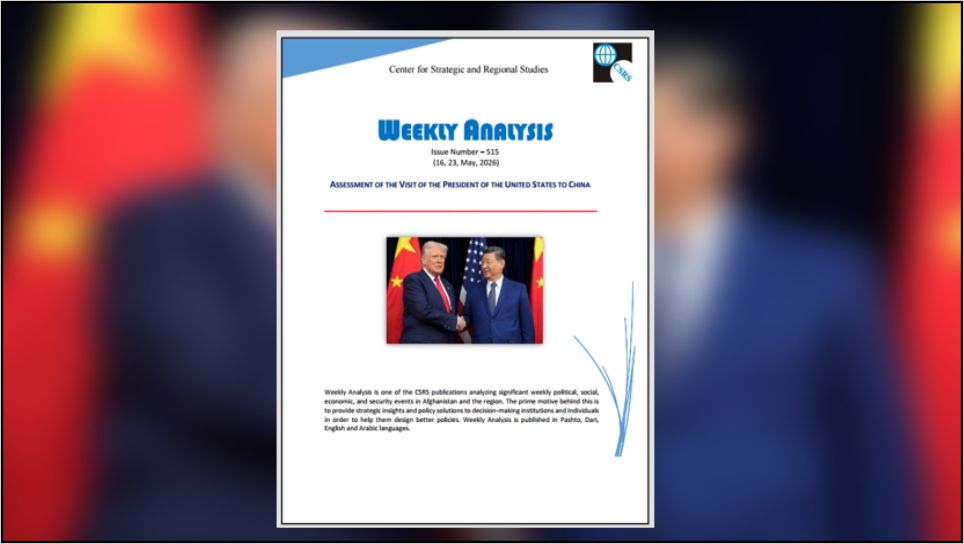
By: Center for Strategic & Regional Studies
Note: Click here for the PDF file of this analysis.
___________________________________________________________________
In this issue:
-
- Assessment of the Visit of the President of the United States to China
- Objectives of Trump’s Visit to China
- Request for Cooperation from China in the Iran Conflict
- Managing the Trade War
- Future Technological Competition in the Middle East
- The Taiwan Issue
- China Announces a New Framework for Relations (Strategic Stability)
- Implications for Afghanistan
- Conclusion
- References
______________________________________________
Introduction
The President of the United States of America, Donald Trump, visited Beijing on May 14–15, 2026, where he met with the President of China, Xi Jinping. This visit is regarded as important for the stability of relations between the United States and China. During the meeting, the leaders of the two countries discussed trade disputes and tariffs, the issue of Taiwan, the Iran–United States conflict and the Zionist regime, the future of the Middle East and the Strait of Hormuz, artificial intelligence (AI), technology, and strategic competition. Trump spoke about China’s purchase of American aircraft and U.S. agricultural products; however, no clear or final agreements were announced. China sought to present itself as a stable and responsible global power, while the United States faced pressure due to the Iran conflict and other global crises. From a historical perspective, this was Trump’s second official visit; he had previously traveled to China in 2017. In this analytical paper, we will assess the visit of the U.S. President, Trump, to China, and will further clarify on which issues the two sides reached agreement and in which areas they achieved results. It will also examine the impact of this visit on regional and global crises.
Objectives of Trump’s Visit to China
Trump traveled to China at a time when the United States is engaged on multiple fronts—ranging from the conflict with Iran to the prolonged war in Ukraine, as well as domestic economic challenges and strategic competition with China. While the Iran conflict remains unresolved, Trump visited China accompanied by senior American officials and executives of major commercial corporations. This raises a fundamental question: what are the objectives of American leaders’ engagement with China at such a sensitive juncture? If U.S.–China relations are not viewed solely through the lens of rivalry, it becomes evident that, alongside competition, the two powers maintain deep economic and commercial ties. The largest volume of global trade occurs between these two countries, and in practice, a complete economic decoupling between them is not easily achievable. In 2024, bilateral trade in goods between the two countries amounted to approximately $658 billion. [1] Following Trump’s return to power, substantial tariffs were imposed on Chinese goods; however, despite these measures, the United States still imported goods worth $318 billion from China in 2025, the majority of which consisted of electronic equipment and rare earth materials. Conversely, in the same year, China imported goods worth $106 billion from the United States, primarily soybeans and other agricultural products produced by American farmers. These figures illustrate that, despite political and military competition, economic necessities continue to sustain mutual interdependence between the two countries. Another sensitive and potentially dangerous point of contention between the two powers is Taiwan. The United States seeks to use Taiwan as an instrument of containment to extract political and economic concessions from China; at the same time, it remains concerned that China may launch an attack on Taiwan, thereby drawing the United States into yet another front of conflict. At present, the United States faces two difficult choices: “containing China” and “maintaining U.S. economic stability.” In a context where the United States has expended billions of dollars in the Iran conflict and its global credibility has been undermined, it is reluctant to allow its competition with China to enter a more critical phase. Accordingly, Washington is attempting to pursue a hybrid strategy combining competition, containment, and engagement—maintaining pressure on China on the one hand, while avoiding direct confrontation on the other. The two countries are engaged in intense competition, and mutual trust between them is absent. The United States seeks to obtain more information regarding China’s military and technological advancements; for this reason, it has repeatedly proposed joint military exercises and the establishment of shared military mechanisms. In this regard, Trump remarked in an interview with Fox News: “They spy on us, and we spy on them.” On the other hand, Xi Jinping is well aware that the United States is preoccupied on multiple fronts, faces economic challenges, relies economically on China, has seen its relations with some traditional allies weaken, and is confronted with internal political difficulties. Consequently, Xi emphasized that both countries must strive to keep the “Thucydides Trap” under control. Overall, the United States seeks to avoid a direct crisis with China, as Washington does not wish—amid pressures arising from Iran, Ukraine, and other global crises—to enter into another large-scale and potentially dangerous global competition; a competition that could threaten its long-term position. In summary, the objectives of Trump’s visit to China can be outlined as follows: managing the pressures of the trade war, securing concessions for American companies, engaging in dialogue regarding the Iran conflict, fostering new economic relations, and conveying to domestic political audiences that he is capable of negotiating effectively with China as well.
Request for Cooperation from China in the Iran Conflict
The United States finds itself in a highly difficult position in the Iran conflict: if it withdraws from the war, this would be perceived as a direct defeat; however, if it continues, a prolonged global conflict would not serve U.S. interests. Consequently, Trump is under significant pressure. China may be the country with the greatest influence over Iran, and U.S. officials—particularly Trump—have repeatedly called on Beijing to utilize this influence in the course of the current conflict. [2] Nevertheless, China’s response has thus far been cautious. The most evident form of Chinese intervention appears to have been encouraging Tehran to accept the April ceasefire conditions. This suggests that Chinese leaders seek to obtain reciprocal concessions from the United States in exchange for such cooperation. Beijing has demonstrated its support and cooperation with Iran through two principal channels:
- Continuing purchases of Iranian oil;
- Providing covert and unofficial support for Iran’s military efforts, including intelligence sharing. [3]
China has not only continued the transfer of components for Iran’s missile and unmanned aerial vehicle programs, but has also assisted during the conflict by providing satellite imagery, enabling Iranian forces to acquire more precise information regarding U.S. and allied targets. For instance, Iran has utilized analytical and tracking data from Chinese geospatial intelligence companies such as “MizarVision,” and reports indicate that Iran has even leased a high-resolution Chinese reconnaissance satellite known as “TEE-01B.” In response to these forms of support, Washington has taken measures ranging from the seizure of vessels carrying Iranian oil to the imposition of sanctions on “MizarVision” and other related companies. [4] The U.S. forces required to blockade Iran’s ports and conduct other potential operations may not be capable of sustaining maritime interdiction efforts over an extended period. Therefore, during this visit, Trump reportedly requested Xi Jinping’s cooperation in the Iran conflict in two key areas: first, to compel Iran to join an agreement prohibiting the development of nuclear weapons; and second, if this proves unachievable and conflict between Iran and the United States escalates, to refrain from supporting Iran.
Managing the Trade War
During both the first and second terms of Trump’s presidency, the United States entered into a trade war with China, imposing heavy tariffs on Chinese goods. In response, China adopted similar measures and imposed tariffs on American products. Moreover, due to China’s cooperation with Iran, the United States has recently increased tariffs on Chinese goods and imposed travel restrictions on certain officials of the Chinese government and the Communist Party. Another objective of the U.S. visit to China was to explore ways of managing this trade war and to identify pathways for ending the cycle of tariffs and sanctions through mutual concessions. [5] However, it appears unlikely that China will yield to such pressure from the United States or abandon its cooperation with Iran in response to trade sanctions. If China were to halt its purchases of Iranian oil, this would represent a significant shift in China–Iran relations—one that the Islamic Republic of Iran and other governments would likely interpret as a betrayal of partnership and an alignment with U.S. interests, while Beijing seeks to project itself as a strong and reliable global power. China is also likely to calculate that a deterioration of relations with Tehran would result in greater long-term costs. Iran is expected to continue exercising considerable control over future maritime routes in the Persian Gulf—a region that supplies nearly half of China’s oil imports and simultaneously constitutes one of the country’s key export corridors. Therefore, if China were to damage its relations with Iran, Tehran could, in the future, pose a threat to Chinese interests in the Middle East and the Persian Gulf.
Future Technological Competition in the Middle East
Saudi Arabia and the United Arab Emirates have, for years, invested billions of dollars to diversify their economies away from oil dependency and to transform their countries into hubs for artificial intelligence, technological production, and energy innovation. Both Washington and Beijing are striving to exert influence over this transformation—one that will shape the Middle East’s digital infrastructure, security partnerships, economic agreements, and geopolitical orientation in the years ahead. During Trump’s visit to the Gulf in May 2025, he announced agreements worth billions of dollars in the fields of technology, defense, and critical minerals. Furthermore, in March of the current year, the UAE Ambassador, Yousef Al Otaiba, confirmed that under an agreement with NVIDIA, the first shipment of advanced artificial intelligence chips from the United States had arrived in the United Arab Emirates. According to Elizabeth, an analyst of international relations, this development demonstrates Washington’s commitment to expanding cooperation with selected Gulf countries. The dispatch of technology-focused delegations to Beijing also indicates that the United States seeks to reach an understanding with China on technological issues—an understanding aimed at preventing direct confrontation between the two powers in the Middle East. [6] The Iran conflict has reinforced the perception in the Middle East that security and defense agreements alone are insufficient; technological transformation and the production of military equipment are also fundamental pillars of power. Moreover, since Middle Eastern countries were not involved in the decision to initiate the war against Iran, there exists the possibility that they may increasingly orient themselves toward China in future technological partnerships. Consequently, the United States has sought to manage this trend and prevent intensified technological competition by pursuing an understanding with China in this domain. If technological competition between the United States and China in the Middle East is effectively managed, new opportunities will emerge for Gulf countries, enhancing their role in shaping the global artificial intelligence order. The influence of these states extends beyond financial investment to include the provision of large-scale electricity resources for AI infrastructure, the allocation of extensive land for data centers, and the establishment of favorable regulatory environments for major global technology companies.
The Taiwan Issue
During his second term in office, Trump has maintained a relatively ambiguous position regarding Taiwan, raising questions within the United States about whether he might reduce support for the island. Beijing considers Taiwan to be a breakaway part of its territory, whereas Taiwan regards itself as an independent government. Under the “One China Policy,” Taiwan is viewed as an inseparable part of China and constitutes a red line for Beijing. [7] U.S. Secretary of State Marco Rubio emphasized that there has been no change in U.S. policy toward Taiwan; however, concerns persisted that Trump—who is often prone to unguarded remarks—might make statements with significant geopolitical consequences. Nevertheless, Trump refrained from making any public comments on Taiwan while in Beijing, despite Xi Jinping’s characterization of the issue as the most critical aspect of U.S.–China relations and his apparent effort to prompt Trump to address it in the context of improving bilateral ties. Trump, however, exercised restraint and remained silent on the matter. [8] However, during his return flight, journalists aboard Air Force One asked whether a major U.S. arms package for Taiwan would proceed. Trump responded that no final decision had yet been made. He stated: “President Xi and I discussed Taiwan extensively. He does not want a war over independence, as it would be a very difficult confrontation.” Trump added: “I listened to his remarks, but I made no comment.” The Trump administration had approved an $11 billion arms package for Taiwan in December, though it has yet to be implemented. Additionally, Congress approved a further $14 billion arms sale in January; however, its execution requires Trump’s formal authorization. [9] When asked whether the United States would militarily intervene in the event of a Chinese attack on Taiwan, Trump did not provide a clear answer. This reflects the longstanding U.S. policy known as “strategic ambiguity,” whereby the United States supplies defensive equipment to Taiwan but does not explicitly state the extent of its military response in the event of a Chinese attack.
China Announces a New Framework for Relations (Strategic Stability)
China announced that the two leaders had agreed on a new perspective titled “Constructive China–U.S. Relations Based on Strategic Stability.” The Chinese Ministry of Foreign Affairs stated that this framework would guide bilateral relations for at least the remaining three years of Trump’s presidential term. The framework is centered on three key pillars:
- Cooperation
- Limited competition
- Management of differences
Helena Legarda, a researcher at the Mercator Institute in Berlin, stated that the objective of this agreement is to “maintain relations on a balanced trajectory.” George Chin, a partner at the Asia Group, also noted that this approach represents a shift from the period of Joe Biden, during which bilateral relations were more explicitly defined in terms of “strategic competition.” [10]
Implications for Afghanistan
The visit of the President of the United States, Trump, to China may produce two possible scenarios: The first scenario is that the visit succeeds in managing competition between the United States and China, leading to an improvement in bilateral relations. Under this scenario, stable relations between the two powers—or at least a reduction in their rivalry—could have positive implications for Afghanistan. The primary positive impact would be the establishment of relative economic stability in the region, from which Afghanistan would also benefit, as the country is in greater need of economic stability than ever before. Furthermore, barriers to China’s “Belt and Road Initiative” would be reduced, enabling Afghanistan to benefit from both the Central Asian corridor of the project and the China–Pakistan Economic Corridor (CPEC) without significant obstacles. However, if the United States continues its competitive posture, it will initially seek to obstruct the Belt and Road Initiative. In addition, in the event of improved relations, Chinese projects—or those supported by China—would likely proceed without external pressure, particularly in the context of connectivity between China, Central Asia, South Asia, and the Middle East. Should these projects be implemented, Afghanistan would undoubtedly benefit from them? The second scenario is the continuation of competition and tensions between China and the United States. In such a situation, this rivalry would also have negative consequences for Afghanistan. The first major impact would be the formation of competing regional blocs. The United States would likely rely on its regional partners—such as India, Japan, South Korea, and Pakistan—to counter China, and the use of these countries would inevitably affect Afghanistan. There is even the possibility that Afghanistan itself could become an arena of competition. The second significant negative consequence would be the transformation of Afghanistan’s geostrategic position—often described as a regional crossroads—into a field of economic rivalry. Such competition, under any circumstances, would not serve Afghanistan’s national interests.
Conclusion
The visit of the President of the United States, Trump, to China was largely ceremonial in nature, with limited tangible outcomes. Some Western analysts believe that Xi Jinping held a relative advantage in the discussions, as China did not soften its position on issues such as Taiwan and economic pressures. The two leaders also discussed the Iran conflict; however, the United States did not achieve its desired outcome of persuading China to withdraw its support for Iran. Regarding the Strait of Hormuz and Taiwan, the primary expectation of the Chinese president was that the United States should refrain from creating tensions or complications in these areas. The positions expressed by both sides suggest that no concrete or substantive agreement was reached, although China announced that the two leaders had agreed on a “new framework for constructive China–U.S. relations based on strategic stability,” which is expected to remain in place for the remainder of Trump’s presidency. Despite this, Trump stated that significant trade deals had been secured for American companies and farmers; however, in practice, no clearly defined agreements have been observed. Moscow does not view this meeting with skepticism, as it remains confident that China will not enter into any arrangement with the United States that would undermine its position or role in the global order. European actors are also awaiting the economic outcomes of the visit, yet no concrete economic achievements have been publicly reported thus far. If relations between China and the United States improve, this would likely reduce the intensity of competition between the two major powers and, under such circumstances, could generate positive effects for Afghanistan. However, if relations fail to improve and rivalry intensifies, this situation will also carry negative consequences for Afghanistan.
References
[1] Amir Haider. “Between Competition and Necessity: Why Did Trump Visit China?”, Aqab Publishing House, 18 May 2026, Accessible Link: [2] Grant Rumley. “The Elephant in the Room: China’s Support to Iran”, Washington Institute for Near East Policy, May 13, 2026, Access link: [3] Ibid. [4] Ibid. [5] Henry Tugendhat. “Weathering the Latest Skirmish in a Ten-Year Trade War” Washington Institute for Near East Policy, May 13, 2026, Access link: [6] Elizabeth Dent. “he Gulf Remains Key to U.S.-China Tech Competition”, Washington Institute for Near East Policy, May 13, 2026, Access link: [7] WILL WEISSERT, AAMER MADHANI, KANIS LEUNG, SIMINA MISTREANU, DARLENE SUPERVILLE and HUIZHONG WU. “Takeaways from Trump’s trip to China: Taiwan, a new framework for relationship and flattery for Xi”, AP News, May 16, 2026, Access link: [8] Ibid. [9] Ibid. [10] Ibid.